
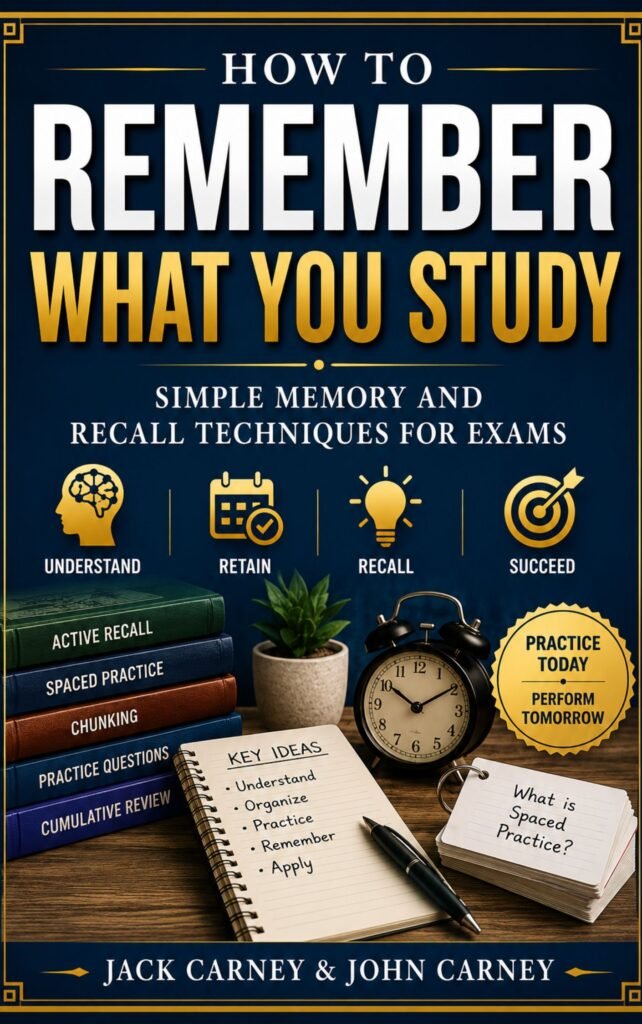
How to Remember What You Study
How to Remember What You Study
Price
$59.00
- Top for Exam Success
- Great for Exams
- In Stock with Fast Delivery
Description
One of the most frustrating experiences in examination preparation is studying something successfully and then discovering that you cannot remember it when you need it. You may read a chapter several times, highlight important sentences, review your notes, and feel completely familiar with the material, only to encounter a practice question a few days later and find that the answer seems to have disappeared. The problem is often not that you failed to study. The problem is that recognizing information while studying and recalling information without assistance are different skills. When you reread a page, the information is directly in front of you, and because it looks familiar, your brain can create the impression that you know it. Once the book closes, however, you must produce that information without seeing it. That is recall, and examinations depend heavily on your ability to recall and apply what you have learned.
Reading is important because it introduces you to the material, but once you understand the basic information, your study process should increasingly require your brain to retrieve it. Instead of repeatedly reading an answer, try to produce the answer without looking. Instead of staring at a formula, close the book and write the formula from memory. Instead of rereading a definition five times, cover it and explain it in your own words. Important facts can be turned into questions that you attempt to answer before checking the material. This changes studying from passive exposure into active retrieval. Retrieval can feel more difficult than rereading because it reveals what you do not know, but that difficulty is useful. When you attempt to recall something and cannot, you have identified a weakness while you still have time to correct it.
The purpose of this book is to help you develop a practical memory system based on active retrieval without requiring complicated memory tricks or elaborate techniques for every fact. Different types of information may require different approaches. Definitions can become easier to remember when you understand them and repeatedly recall them. Lists can be divided into smaller groups, formulas can be connected to what each part represents, sequences can be reconstructed in the proper order, and numerical values can be connected to the rules or concepts they represent. Understanding and memory should work together because memorizing words without understanding their meaning can create fragile knowledge. When you understand why a formula works, what a definition means, or how one step leads to another, you create additional ways to retrieve that information when a question presents the concept differently.
Some information still must be memorized directly, including definitions, formulas, dates, values, terminology, procedures, classifications, abbreviations, and other details that need to be available quickly. One of the most effective ways to strengthen this information is to review it over time instead of concentrating all of your studying into one long session. Study the material, test yourself, leave it for a period of time, return to it, and test yourself again. Mixing older material with new material can also prevent earlier lessons from disappearing as you progress. Practice questions and flashcards are especially useful when they require you to attempt an answer before seeing it. A correct answer strengthens retrieval, while an incorrect answer identifies exactly what requires additional attention. The goal is to reach the point where you can explain or apply information without looking and can still retrieve it several days later.
Memory preparation should also reflect the examination itself. You do not need to devote equal time to memorizing everything. Information that appears frequently, supports several types of questions, is difficult to look up, or is necessary for calculations and problem solving deserves greater attention. Information that is less important or easily located in an approved reference may require less memorization. Your goal is not to become a human copy of the textbook. Your goal is to remember and retrieve the information that helps you answer examination questions. The techniques in this book will therefore focus on active recall, spaced review, organizing information into manageable groups, remembering formulas and numbers, using practice questions and flashcards effectively, and keeping older material active while you continue learning new material.
The central idea is simple: do not measure studying by how many times you have looked at the information. Measure it by how reliably you can produce and use that information when it is no longer in front of you. That is the difference between recognizing something you studied and actually being able to use it when the examination asks for it. The first step toward developing stronger recall is understanding why repeatedly reading the same material can create the illusion of learning even when your ability to retrieve that information remains weak. That is where the first chapter begins.
Return Policy
All sales are final.
We are unable to issue a refund for your purchase. Please confirm the items that you require prior to making your purchase.
All items are non-returnable unless previously authorized and approved by a supervisor. A 30% restocking fee will be assessed on all returns that have been authorized and approved by a supervisor.
Contact us to obtain a Return Authorization Number before sending any items back to us. We cannot accept a return without a Return Authorization Number. A copy of the itemized customer invoice listing the returned items must be enclosed with your return shipment. Shipping charges are non-reimbursable. We are unable to accept a credit card draft as a sales receipt.
All returns must be in salable condition.
We are unable to accept any returns on:
- All sale books
- All directories
- All codes and technical standards
- All society/association documents
- All study guides including EIT/FE/PE review texts and solution guides
- Shrink wrapped items that have been opened
- Software or books with disk packages that have been opened
- Items that have been special ordered
- PDF’s
- Online courses
We reserve the right to modify this Return Policy at our sole discretion, any such revision will be binding and effective immediately following the posting of the revised Return Policy on this website.
Shipping Information
Delivery charges are calculated on a per-product basis. Please make note of the delivery charges associated with each item.
Orders are shipped Monday – Friday. We do not ship on Saturday, Sunday and Major Holidays.
We reserve the right to modify this Shipping Policy at our sole discretion, any such revision will be binding and effective immediately following the posting of the revised Shipping Policy on this website.