
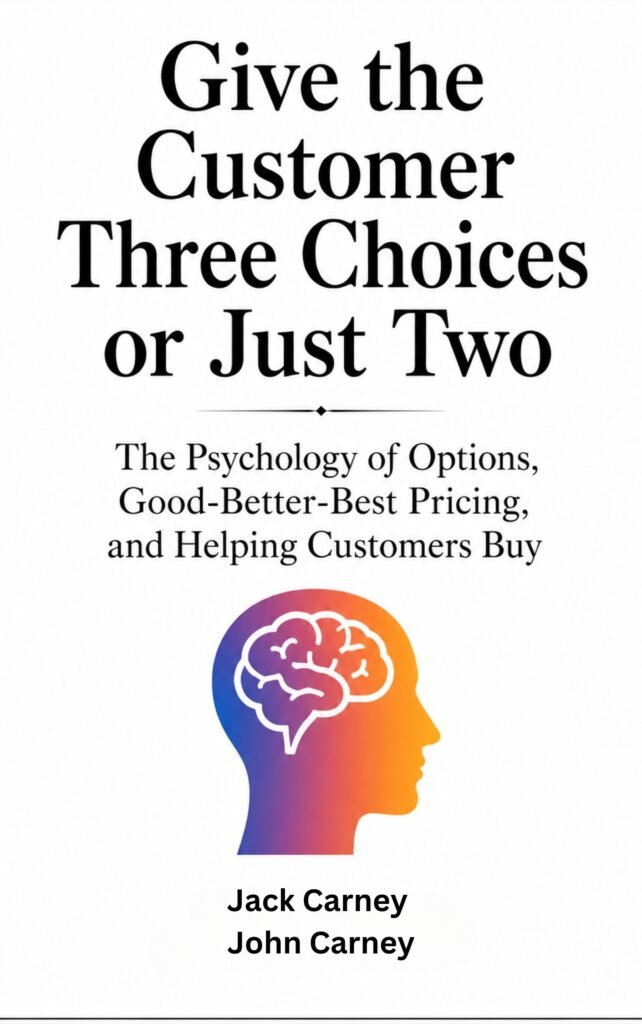
Give the Customer Three Choices or Just Two
Give the Customer Three Choices or Just Two
Price
$59.00
- Top for Exam Success
- Great for Exams
- In Stock with Fast Delivery
Description
Customers rarely make purchasing decisions based on price alone. They compare price with what they believe they are receiving, how urgently they need the work, how much they trust the person making the recommendation, and what alternatives are available. One of the most useful things a tradesperson can do during this process is give the customer a reasonable number of clear choices. Instead of making the conversation only about whether the customer will buy, choices allow the conversation to become about which solution best fits the customer’s needs.
There are two particularly useful approaches. The first is the two-choice approach, which may be described in sales training as an alternative choice, two-card choice, binary choice, or sometimes a forced choice. Instead of presenting one solution, the tradesperson presents two legitimate alternatives. A customer might compare repair with replacement, standard with upgraded, or a lower-cost solution with one providing additional benefits. The purpose should not be to trick customers into believing they must purchase one of the two choices. The purpose is to make a complicated decision easier to understand.
The second approach is the three-choice system commonly described as Good-Better-Best. Instead of presenting a single price, the contractor develops three meaningful levels of solution. Good properly addresses the customer’s basic need. Better provides additional benefits for an additional investment. Best provides the strongest overall package for customers who value the additional features, performance, warranty, durability, efficiency, convenience, or other advantages it may provide. The customer can compare the differences and decide how much value they want to purchase.
These approaches become even more powerful when tradespeople understand the psychology behind them. Customers use reference points when evaluating price. They compare one option with another. A premium option can affect how the middle option is perceived, while a lower-priced option can establish what the customer receives at the basic level. The middle choice may become attractive because it balances price and benefits. At the same time, too many choices can create confusion and cause customers to delay making any decision at all. Effective option selling is therefore not about showing customers everything that could possibly be sold. It is about organizing legitimate choices so the differences are easy to understand.
Options can also help tradespeople protect profit. When a customer says a proposal is too expensive, the salesperson does not necessarily need to immediately discount the same work. There may be a legitimate lower-cost solution with fewer benefits or a different scope. The customer can decide whether the additional benefits of the higher-priced option justify the additional investment. Instead of the contractor automatically surrendering margin, the customer participates in deciding what level of solution and value to purchase.
Throughout this book, the central principle will remain simple. Give customers choices, explain the differences, make a professional recommendation when appropriate, and allow the customer to decide. Two-choice selling, Good-Better-Best pricing, alternative choice, price anchoring, and other sales psychology concepts are most valuable when they make purchasing easier to understand rather than harder to escape. Used correctly, choices can reduce customer doubt, protect contractor profit, and turn the sales conversation into what it should have been all along: helping the customer select the solution that makes the most sense for them.
Return Policy
All sales are final.
We are unable to issue a refund for your purchase. Please confirm the items that you require prior to making your purchase.
All items are non-returnable unless previously authorized and approved by a supervisor. A 30% restocking fee will be assessed on all returns that have been authorized and approved by a supervisor.
Contact us to obtain a Return Authorization Number before sending any items back to us. We cannot accept a return without a Return Authorization Number. A copy of the itemized customer invoice listing the returned items must be enclosed with your return shipment. Shipping charges are non-reimbursable. We are unable to accept a credit card draft as a sales receipt.
All returns must be in salable condition.
We are unable to accept any returns on:
- All sale books
- All directories
- All codes and technical standards
- All society/association documents
- All study guides including EIT/FE/PE review texts and solution guides
- Shrink wrapped items that have been opened
- Software or books with disk packages that have been opened
- Items that have been special ordered
- PDF’s
- Online courses
We reserve the right to modify this Return Policy at our sole discretion, any such revision will be binding and effective immediately following the posting of the revised Return Policy on this website.
Shipping Information
Delivery charges are calculated on a per-product basis. Please make note of the delivery charges associated with each item.
Orders are shipped Monday – Friday. We do not ship on Saturday, Sunday and Major Holidays.
We reserve the right to modify this Shipping Policy at our sole discretion, any such revision will be binding and effective immediately following the posting of the revised Shipping Policy on this website.