
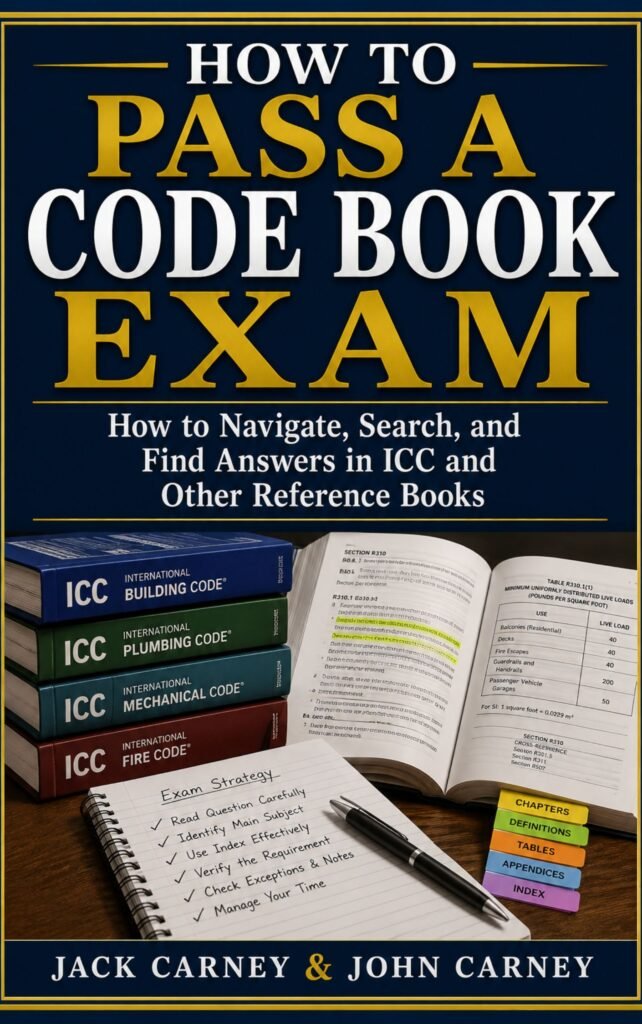
How to Pass a Code Book Exam
How to Pass a Code Book Exam
Price
$59.00
- Top for Exam Success
- Great for Exams
- In Stock with Fast Delivery
Description
A code book examination is different from an ordinary test because knowing the trade is only part of the challenge. You may have hundreds of pages of technical requirements, definitions, tables, exceptions, figures, appendices, and cross-references available during the examination, but having the reference does not automatically make the answers easy to find. A skilled plumber, HVAC technician, electrician, building professional, inspector, or contractor may understand the work extremely well and still struggle with a code examination if that person cannot navigate the required reference efficiently. Field knowledge and code-book knowledge overlap, but they are not identical skills. A code examination requires you to understand the subject while also locating and interpreting written requirements before the examination clock runs out.
Trying to memorize an entire code book is usually unrealistic and unnecessary. A better strategy is to understand the major concepts while becoming extremely familiar with the organization of the reference. Think of a code book as a city. You do not need to memorize every address to travel through a city efficiently, but you should understand the major neighborhoods, roads, and landmarks. In the same way, you should know the major chapters and subject areas of your code book, understand how sections and subsections are organized, know where definitions are located, recognize important tables, and become comfortable using the index. When a question gives you a destination, your knowledge of the book should help you determine where to begin looking.
Successful code-book navigation depends heavily on learning how the reference communicates information. Section numbers provide a map through the book, while the index helps translate examination questions into useful search terms. Tables can provide answers quickly, but only when you select the correct row, column, units, conditions, and notes. Definitions can resolve questions involving technical terminology, while exceptions can change what appears to be a straightforward general rule. Cross-references may send you from one section to another, and learning to follow those connections efficiently is an important part of becoming comfortable with the reference. Tabs and highlighting may also improve navigation when permitted by the testing organization, but they should simplify the book rather than cover it with so many markings that finding information becomes more difficult.
The most effective way to develop these skills is through repeated timed practice. Take a practice question, identify the main subject, select a useful search term, locate the appropriate chapter or index entry, find the relevant section or table, check applicable definitions, exceptions, notes, and cross-references, and then answer the question. If the search takes too long, determine why and improve the route. Over time, a large reference begins to feel smaller because you recognize its major chapters, common terminology, important tables, and section-number patterns. Your objective is not merely to memorize the answer to individual practice questions. You are developing a navigation process that can help you locate answers to questions you have never seen before.
Passing a code book examination therefore requires a combination of knowledge, navigation, speed, and judgment. You need enough subject knowledge to understand what a question is asking, enough familiarity with the reference to know where the answer is likely to be located, enough navigation skill to find the information efficiently, and enough judgment to recognize when a search is consuming too much examination time. This book will show you how to understand the organization of ICC and other technical reference books, create a mental map of the material, use indexes and section numbers efficiently, locate and interpret tables, follow cross-references, prepare permitted references for faster navigation, practice timed lookups, and develop an examination-day strategy. The objective is not to memorize the entire code book. The objective is to know how to use it.
Return Policy
All sales are final.
We are unable to issue a refund for your purchase. Please confirm the items that you require prior to making your purchase.
All items are non-returnable unless previously authorized and approved by a supervisor. A 30% restocking fee will be assessed on all returns that have been authorized and approved by a supervisor.
Contact us to obtain a Return Authorization Number before sending any items back to us. We cannot accept a return without a Return Authorization Number. A copy of the itemized customer invoice listing the returned items must be enclosed with your return shipment. Shipping charges are non-reimbursable. We are unable to accept a credit card draft as a sales receipt.
All returns must be in salable condition.
We are unable to accept any returns on:
- All sale books
- All directories
- All codes and technical standards
- All society/association documents
- All study guides including EIT/FE/PE review texts and solution guides
- Shrink wrapped items that have been opened
- Software or books with disk packages that have been opened
- Items that have been special ordered
- PDF’s
- Online courses
We reserve the right to modify this Return Policy at our sole discretion, any such revision will be binding and effective immediately following the posting of the revised Return Policy on this website.
Shipping Information
Delivery charges are calculated on a per-product basis. Please make note of the delivery charges associated with each item.
Orders are shipped Monday – Friday. We do not ship on Saturday, Sunday and Major Holidays.
We reserve the right to modify this Shipping Policy at our sole discretion, any such revision will be binding and effective immediately following the posting of the revised Shipping Policy on this website.