
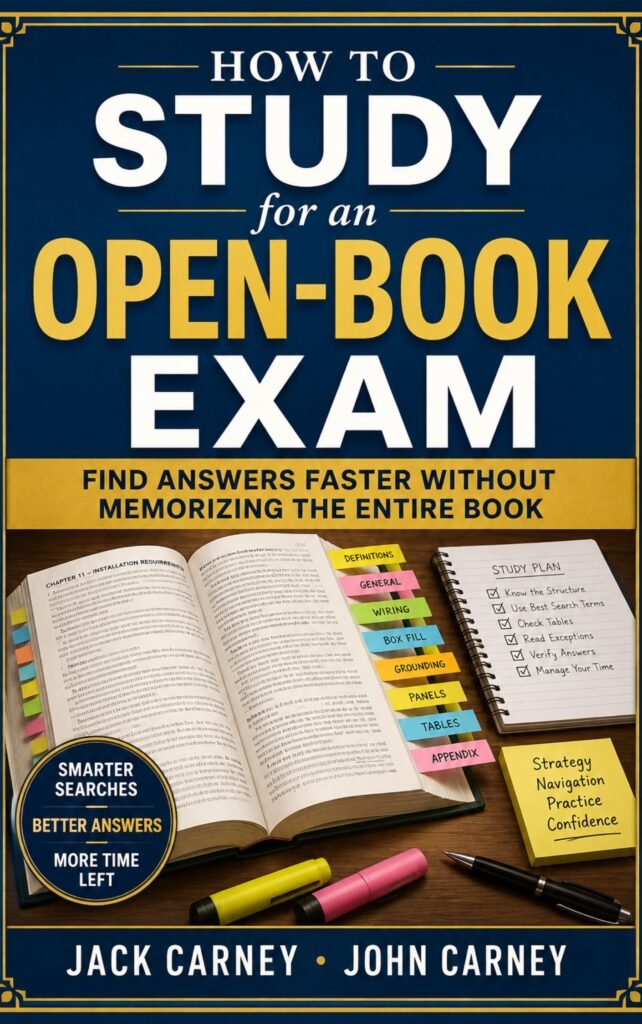
How to Study for an Open-Book Exam
How to Study for an Open-Book Exam
Price
$59.00
- Top for Exam Success
- Great for Exams
- In Stock with Fast Delivery
Description
The words open book can create a dangerous sense of confidence. If you are allowed to bring a book into the examination, it is easy to assume that you do not need to study very much. After all, if you do not know an answer, you can simply look it up. That strategy sounds reasonable until the clock starts. Imagine sitting in front of a 600-page reference book with a question on the screen and less than two minutes available, on average, for each question. You know the answer is somewhere inside the book. You just do not know where. You check the table of contents. Then you turn to the index. You find a possible keyword and go to the referenced page. The information is not exactly what you need, so you follow another reference to a different section. You read several paragraphs, return to the question, and realize that four minutes have disappeared. Now imagine doing that for fifty questions. The problem becomes obvious.
An open-book examination is not necessarily a test of whether you can find an answer eventually. It may be a test of whether you can find the right information quickly enough to complete the examination. That makes preparation essential. The most successful open-book test takers usually do not walk into the examination planning to search the book for every answer. They already know a substantial amount of the material. More importantly, they know the reference. They understand how it is organized. They know where major subjects are located, how chapters are arranged, how the index works, where important tables can be found, and how one section references another. The book becomes a tool rather than a storage container. That distinction is at the center of this guide.
You do not need to memorize every page of a large reference book. In many cases, attempting to do so would be an inefficient use of your study time. Instead, you need a combination of knowledge and navigation. You should know enough of the subject to recognize what a question is asking and enough about the book to know where the answer is likely to be found. Think about the difference between knowing an answer and knowing where an answer lives. If a question asks something you know immediately, answer it and continue. There is no reason to spend valuable examination time proving the answer by searching through the book unless you have a specific reason to verify it. If you do not know the exact answer but know that the subject is covered in a particular chapter, you have already reduced your search dramatically. If you also know the likely keyword, section, or table, you may be able to locate the information within seconds. That is the skill an open-book candidate should develop.
Many open-book examinations are used for professional licensing, skilled trades, technical certifications, law, business, safety, engineering, codes, standards, policies, regulations, and other subjects where large amounts of reference material are involved. In these situations, memorizing every requirement may be unrealistic. Knowing how information is organized becomes extremely valuable. This is especially true when the examination is based on code books, standards, regulations, manuals, or other structured references. These books are not usually intended to be read like novels from the first page to the last. They are designed so that specific information can be located when needed. Your preparation should reflect that design.
Instead of merely reading hundreds of pages, learn the structure. Where are definitions located? Where are major subjects located? How are sections numbered? Where are tables placed? How does the index describe subjects? How are exceptions presented? How do references direct you from one section to another? These questions may seem less important than memorizing facts, but during a timed open-book examination they can save enormous amounts of time.
Tabs and highlighting may also help when the examination rules permit them. However, these tools must be used carefully. A book with hundreds of tabs can become harder to navigate than a book with none. If every sentence is highlighted, nothing stands out. The purpose of preparing a reference is to make important information easier to locate. Every tab, highlight, note, or permitted marking should serve that purpose.
You should also learn how to turn examination questions into searches. A question may contain several sentences, but only one or two words may be useful for locating the answer in an index. Choosing the wrong search term can send you to the wrong part of the book. For example, a question may describe a particular piece of equipment and ask about a required clearance. Searching for a general word such as equipment may produce dozens of possibilities. Searching for the specific equipment name or the concept of clearance may lead you much closer to the answer. Learning to identify useful search terms is a skill.
So is recognizing when not to search. If you know an answer with confidence, searching the reference may waste time. If a question requires a simple calculation you have practiced repeatedly, perform the calculation. If you can eliminate three choices using knowledge you already possess, another five-minute search may not be necessary. Your book should support your knowledge rather than replace it.
This means open-book preparation still requires studying. You need enough familiarity with the subject to understand the terminology used in questions. You need enough knowledge to recognize when a search result actually answers the question. You need enough understanding to notice when a general rule has an exception. Simply finding a sentence containing the same words as the question does not guarantee that you have found the correct answer. Context matters. A section may provide a general requirement and then list exceptions immediately afterward. A table may apply only under certain conditions. A definition may refer you to another section. Good reference navigation includes reading enough surrounding information to understand what you found.
Time management will therefore remain important throughout this book. You need to know when to search, how long to search, when to stop searching, and when to return to a difficult question later. This can be practiced. In fact, timed lookup drills can become one of the most valuable parts of your preparation. Instead of simply answering practice questions, time how long it takes you to locate the supporting information in the reference. At first, a search may take several minutes. With repetition, the same type of search may take less than a minute. That improvement can make a major difference over an entire examination.
Throughout this short book, we will build a practical open-book examination system. You will learn why open-book examinations can be harder than expected, how to learn the structure of your reference materials, how to use tabs and highlighting effectively when permitted, how to turn questions into search terms, how to practice finding answers against the clock, how to use indexes, tables, and references, and how to combine all of these skills into an exam-day strategy. The objective is not to memorize the entire book. The objective is also not to depend on the book for everything. The strongest approach lies between those extremes. Know what you can. Know where to find what you cannot remember. Know how long you can afford to search. Then practice until finding information becomes a skill rather than an emergency. That preparation begins by understanding why an open-book examination may be much more difficult than its name suggests.
Return Policy
All sales are final.
We are unable to issue a refund for your purchase. Please confirm the items that you require prior to making your purchase.
All items are non-returnable unless previously authorized and approved by a supervisor. A 30% restocking fee will be assessed on all returns that have been authorized and approved by a supervisor.
Contact us to obtain a Return Authorization Number before sending any items back to us. We cannot accept a return without a Return Authorization Number. A copy of the itemized customer invoice listing the returned items must be enclosed with your return shipment. Shipping charges are non-reimbursable. We are unable to accept a credit card draft as a sales receipt.
All returns must be in salable condition.
We are unable to accept any returns on:
- All sale books
- All directories
- All codes and technical standards
- All society/association documents
- All study guides including EIT/FE/PE review texts and solution guides
- Shrink wrapped items that have been opened
- Software or books with disk packages that have been opened
- Items that have been special ordered
- PDF’s
- Online courses
We reserve the right to modify this Return Policy at our sole discretion, any such revision will be binding and effective immediately following the posting of the revised Return Policy on this website.
Shipping Information
Delivery charges are calculated on a per-product basis. Please make note of the delivery charges associated with each item.
Orders are shipped Monday – Friday. We do not ship on Saturday, Sunday and Major Holidays.
We reserve the right to modify this Shipping Policy at our sole discretion, any such revision will be binding and effective immediately following the posting of the revised Shipping Policy on this website.