
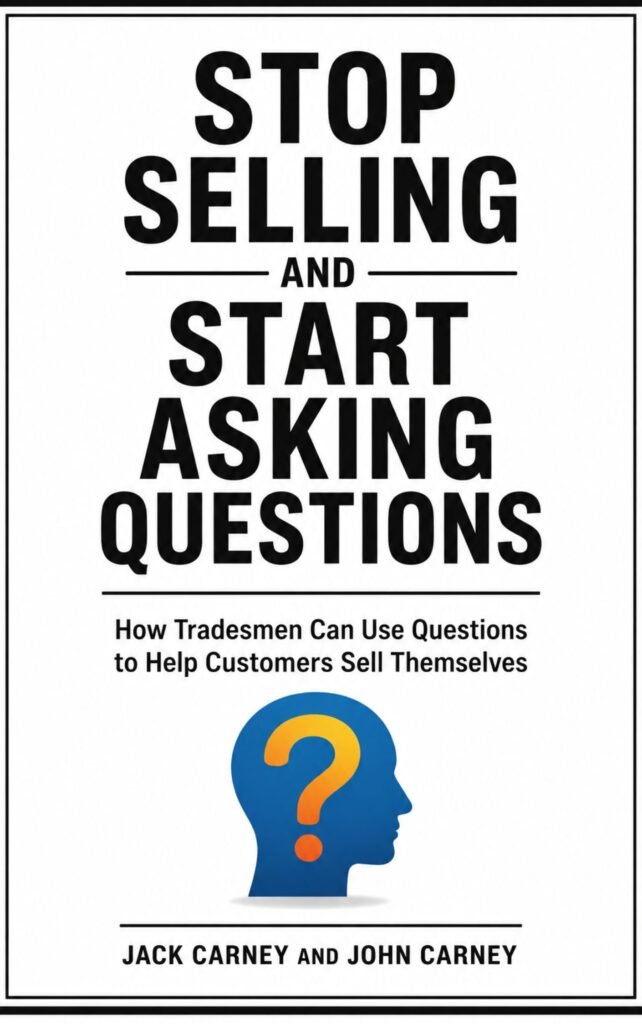
Stop Selling and Start Asking Questions
Stop Selling and Start Asking Questions
Price
$59.00
- Top for Exam Success
- Great for Exams
- In Stock with Fast Delivery
Description
Many tradespeople believe selling begins when they start explaining. The technician diagnoses the problem and immediately begins talking about equipment, materials, specifications, warranties, features, prices, and everything the company can provide. The assumption is understandable. The tradesperson possesses technical knowledge that the customer does not have, so explaining that knowledge seems like the natural way to persuade the customer. Yet some of the most productive sales conversations begin with the opposite approach. Instead of immediately telling customers what they should do, the tradesperson begins by asking questions and listening carefully to the answers.
Questions matter because the technical problem and the customer’s problem are not always exactly the same. A technician may diagnose a failed component while the homeowner is thinking about three breakdowns during the previous year. A plumber may see a leaking water heater while the customer is worried about property damage and whether the family will have enough hot water. An electrician may identify an outdated panel while the homeowner is primarily concerned about adding equipment during an upcoming renovation. The technical diagnosis tells you what is happening to the system, while questions help reveal what the situation means to the customer.
Good questions also prevent tradespeople from making assumptions. You cannot determine someone’s budget by looking at their house, vehicle, clothing, age, or occupation. You cannot assume that every homeowner wants the cheapest repair, the longest-lasting solution, the highest efficiency, or the most expensive equipment. One customer may care primarily about keeping today’s expense low, while another may willingly invest considerably more to reduce the possibility of another breakdown. The only reliable way to discover these priorities is to ask and listen.
The purpose of asking questions is not to trap customers into saying yes. Questions should help both sides understand the decision. The customer gains an opportunity to explain concerns, priorities, frustrations, and desired outcomes, while the tradesperson gains the information needed to make a more appropriate recommendation. This changes the sales conversation from a presentation delivered to the customer into a discussion conducted with the customer.
There is another important advantage. People often place considerable weight on conclusions they reach themselves. A salesperson can repeatedly tell a homeowner that reliability is important, but the statement becomes much more meaningful when the homeowner says, “I’m tired of paying for repairs every summer. I want something I don’t have to keep worrying about.” The customer has now expressed a personal reason for considering a different solution. The tradesperson does not need to manufacture that motivation because the customer has already explained it.
Throughout this book, we will examine how questions can uncover the real problem, identify what customers value, clarify price concerns and objections, and make purchasing decisions easier without relying on high-pressure closing techniques. The objective is not to stop explaining altogether. Tradespeople still need to diagnose accurately, provide professional recommendations, explain technical information, and answer questions. The change is in the order of the conversation. Before you spend your time telling customers what you think matters, give them an opportunity to tell you what matters to them. That begins with one of the simplest and most valuable skills in selling: stop talking and start listening.
Return Policy
All sales are final.
We are unable to issue a refund for your purchase. Please confirm the items that you require prior to making your purchase.
All items are non-returnable unless previously authorized and approved by a supervisor. A 30% restocking fee will be assessed on all returns that have been authorized and approved by a supervisor.
Contact us to obtain a Return Authorization Number before sending any items back to us. We cannot accept a return without a Return Authorization Number. A copy of the itemized customer invoice listing the returned items must be enclosed with your return shipment. Shipping charges are non-reimbursable. We are unable to accept a credit card draft as a sales receipt.
All returns must be in salable condition.
We are unable to accept any returns on:
- All sale books
- All directories
- All codes and technical standards
- All society/association documents
- All study guides including EIT/FE/PE review texts and solution guides
- Shrink wrapped items that have been opened
- Software or books with disk packages that have been opened
- Items that have been special ordered
- PDF’s
- Online courses
We reserve the right to modify this Return Policy at our sole discretion, any such revision will be binding and effective immediately following the posting of the revised Return Policy on this website.
Shipping Information
Delivery charges are calculated on a per-product basis. Please make note of the delivery charges associated with each item.
Orders are shipped Monday – Friday. We do not ship on Saturday, Sunday and Major Holidays.
We reserve the right to modify this Shipping Policy at our sole discretion, any such revision will be binding and effective immediately following the posting of the revised Shipping Policy on this website.