
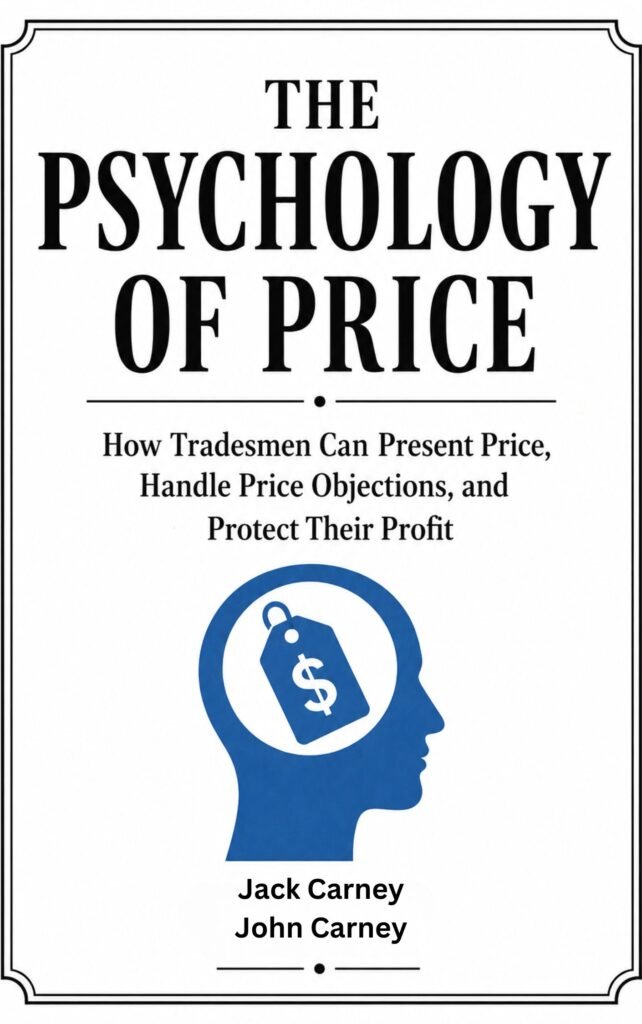
The Psychology of Price
The Psychology of Price
Price
$59.00
- Top for Exam Success
- Great for Exams
- In Stock with Fast Delivery
Description
Price is one of the most uncomfortable subjects in the trades. A plumber may confidently diagnose a difficult problem, an HVAC technician may explain exactly why a system failed, an electrician may identify a complicated electrical issue, and a contractor may know precisely what is required to complete a project correctly. Then comes the moment when someone has to tell the customer what the work costs. Suddenly the confident professional becomes hesitant. The voice changes, the explanation becomes longer, and sometimes the tradesperson begins defending the price before the customer has even objected.
Customers notice this discomfort. When someone presents a $7,500 proposal as though they are embarrassed by it, the customer may naturally wonder whether there is something wrong with the price. The salesperson may say, “I know this is expensive,” before the homeowner has said anything. They may immediately begin discussing discounts or apologizing for what the company charges. Instead of increasing confidence, the salesperson has unintentionally created doubt.
Understanding price psychology begins with recognizing that customers do not evaluate numbers in isolation. A customer sees a $5,000 proposal and immediately compares that number with something. The comparison might be another estimate, a previous repair, something found online, what a friend paid several years ago, what the customer expected before the appointment, or simply what $5,000 feels like compared with other household expenses. This comparison becomes a reference point, and the proposed price can feel inexpensive, reasonable, or extremely high depending on that reference point.
This is why price and value cannot be separated. A customer who sees only a $12,000 number may experience the proposal as a large expense. A customer who clearly understands the problem, scope, alternatives, workmanship, warranty, expected result, and differences among available solutions has more information with which to evaluate the same $12,000. The price has not changed, but the customer now understands what the price is supposed to purchase. The objective is not to hide or minimize the cost. The objective is to provide enough context for the customer to evaluate it intelligently.
Trades businesses also need to remember that profit is not something to be ashamed of. A professional company needs money to pay employees, maintain vehicles, purchase tools, carry insurance, provide training, operate an office, replace equipment, advertise, handle warranty obligations, pay taxes, and remain available when customers need service. A contractor who consistently sells work without enough profit eventually creates problems for employees, customers, or both. Protecting profit therefore does not conflict with serving customers when the company is delivering legitimate value at a clearly communicated price.
Throughout this book, we will examine how customers interpret prices, why some numbers produce immediate resistance, how value affects willingness to buy, how prices can be presented confidently, why choices can make purchasing decisions easier, and what to do when customers say the work costs too much. The objective is not to teach tradespeople how to make an expensive price look cheap. It is to teach them how to make the price understandable. When customers understand what they are buying and tradespeople understand what their work must earn, price can become a straightforward part of a professional conversation rather than the most uncomfortable moment in the sale.
Return Policy
All sales are final.
We are unable to issue a refund for your purchase. Please confirm the items that you require prior to making your purchase.
All items are non-returnable unless previously authorized and approved by a supervisor. A 30% restocking fee will be assessed on all returns that have been authorized and approved by a supervisor.
Contact us to obtain a Return Authorization Number before sending any items back to us. We cannot accept a return without a Return Authorization Number. A copy of the itemized customer invoice listing the returned items must be enclosed with your return shipment. Shipping charges are non-reimbursable. We are unable to accept a credit card draft as a sales receipt.
All returns must be in salable condition.
We are unable to accept any returns on:
- All sale books
- All directories
- All codes and technical standards
- All society/association documents
- All study guides including EIT/FE/PE review texts and solution guides
- Shrink wrapped items that have been opened
- Software or books with disk packages that have been opened
- Items that have been special ordered
- PDF’s
- Online courses
We reserve the right to modify this Return Policy at our sole discretion, any such revision will be binding and effective immediately following the posting of the revised Return Policy on this website.
Shipping Information
Delivery charges are calculated on a per-product basis. Please make note of the delivery charges associated with each item.
Orders are shipped Monday – Friday. We do not ship on Saturday, Sunday and Major Holidays.
We reserve the right to modify this Shipping Policy at our sole discretion, any such revision will be binding and effective immediately following the posting of the revised Shipping Policy on this website.